|
When you think of the words “Sealed
with a Kiss” you are probably thinking about the 1960’s song
of the same name by Brian Hyland. The song refers to two
lovers who have had to part ways over the summer. They
promise to send love and dreams in daily letters “sealed
with a kiss”. They also bind each other to a pledge, under
the seal of a kiss, that they would reunite in September.
But seriously, the term actually
comes from Roman times, when literacy rates were low and a
signature could not be relied on, so a public kiss was used
to seal a legal contract. It became the signature of choice
in the Middle Ages, when few could write and documents were
sealed with an x embossed in wax or lead. This may be when
the “x'' first became associated with the kiss. It was
customary to close books with a kiss, and oaths of fealty to
kings were sealed with a kiss.
Another interesting historical fact
is the history of the wax seal. This process dates back to
the ancient seals in Mesopotamia for authenticating clay
tablets, but they became prominent in the Middle Ages for
sealing documents, like letters and decrees, primarily among
the wealthy and clergy. Used as a personal signature or
symbol of authority, often featuring a unique crest or
emblem, these seals authenticated correspondence, and their
use spread to commoners by the 13th century. Wax seals
largely fell out of use with the rise of modern,
self-sealing envelopes in the late 19th and early 20th
centuries, but they are now experiencing a resurgence as a
decorative element.
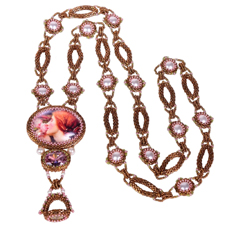
Sealed with
a Kiss is a long
sautoir-style necklace with lots of detail. The central
pendant is a painting under glass that is bezeled. The
pendent details continue with the addition of pearls, a
bezeled oval CZ and a decorative wax seal. The necklace
chain is quite amazing. Marquise-shaped units alternate with
bezeled pearl cabochons for a stunning necklace chain.
Skill level:
Intermediate to advanced.
Workshop
length: This is a 1-day
workshop.
Dimensions:
Pendant is 4” long and the
necklace chain is 32” long.
Techniques:
-
Bezel work
-
Flat and tubular peyote
stitch with increasing and decreasing
-
Stitching-in-the-ditch
-
Surface embellishment
|