|
Description: |
Today, we take them for granted. But in
history, the sewing needle was a treasured item. Early
mankind, say around 28,000 BC, used bone, antler or wood to
carve out needles that would be used for sewing plant
fibers, gut or sinew. These needles didn’t have an eye; they
had what would be more like slits in one end that would use
compression to hold the fiber.
By the Bronze age, around 7,000 BC,
needles have been found in copper, iron and bronze. Sadly,
preservation of these items is virtually impossible, as the
materials oxidized so much, that the metallic needles, of
this time period, are rarely found in good condition.
In 1496, Leonardo DaVinci constructed a
machine to point sewing needles. Up until this time, needles
were crude and roughly made, usually by a blacksmith. In
1567, a factory in England learned how to draw fine steel
wires. They then produced over 90% of the world’s needles by
the 19th century.
As we move forward in history, handmade
needles with a threading hole now, needed to be protected in
some sort of a case. Until the industrial age of needle
making, needles were still handmade and were considered
exotic treasures that were special and rare.
One of the earliest cases is in the
Swedish History Museum. The cylindrical case is made of
bronze and is from the 5th – 14th century and attributed to
the Viking Era. Needle cases, or books, can be found in many
different varieties and made out of many different
materials. Bronze, brass, precious metals, bone, leather,
ivory and fabric were all used through the ages. From screw
top, cylindrical cases to decorative little needle books,
these little treasures held the precious cargo of the not so
simple needle!
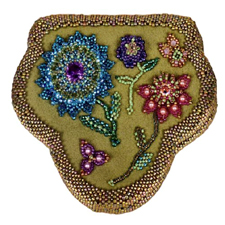
Needle Little Bitta of Love? is
inspired by the historical perspective of the needle and the
case unto which it would be stored. The lid of the case is
embellished with CZs in a beaded floral motif and has a
layered system of suede and plastic, creating a sturdy case
for our precious beading needles.
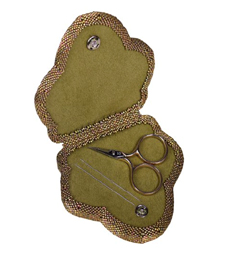
The base of the case is actually
magnetic, so our needles will stay where we put them! The
two tongue-shaped needle case components are hinged in the
back, allowing the two pieces to be opened easily. CZs are
set into the endcaps on the hinge, adding a bit of elegance.
A snap in the front, keeps the case closed and our needles
safe and sound.
Dimensions:
2-1/2 inches wide by 3-1/8 inches (approximate) |